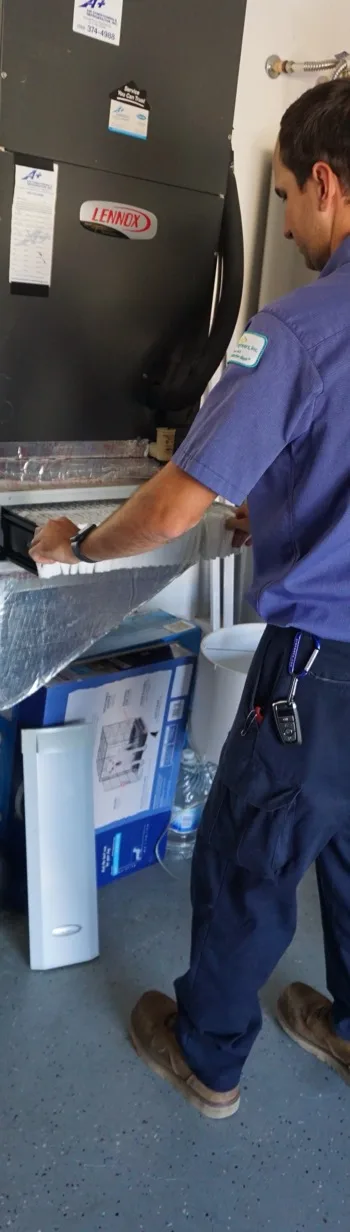
How to Clean Your AC Condensate Drain Line With Vinegar in 6 Steps
A clogged condensate drain is one of the most common reasons Gainesville homeowners end up calling for AC repair, and it is almost always preventable. Flushing the line with a quarter cup of distilled white vinegar once a month kills the mold, algae, and biofilm that build up inside the pipe and cause backups.
Need AC Service in Gainesville?
If your drain pan is overflowing or the line is fully clogged, our technicians can clear it fast and inspect the rest of your system at the same time.
Family-owned since 1998 • American Standard Dealer



Operated Since 1998
Emergency Service
If you have ever come home to water dripping from a ceiling vent or a soggy spot near your air handler, a clogged condensate line is the most likely cause. Here is exactly how to clear it yourself, plus how to keep it from clogging again.
How to Clean Your AC Drain Line With Vinegar in 6 Steps
The active step is pouring a quarter cup of distilled white vinegar into the cleanout port and letting it sit for 30 minutes. Vinegar's acidity kills the mold, algae, mildew, and bacteria that grow inside the dark, damp pipe. Repeat monthly during cooling season for the best results.
Switch off the system at the thermostat, then flip the dedicated breaker for the indoor air handler. Working on a live system risks shock and lets condensation keep flowing while you are trying to clear the line.
The drain is a length of white PVC pipe, usually three quarters of an inch, that runs out of the air handler. Indoors, you can trace it from the air handler in your closet, attic, or garage. Outdoors, it terminates near your outdoor condenser unit, often dripping water during a cooling cycle.
Just past the air handler the drain has a T-shaped vent tee with a removable cap on top. That is the cleanout port. Unscrew or twist the cap off and shine a flashlight inside to look for visible sludge.
Use a small funnel and pour a quarter cup of distilled white vinegar down the open cleanout. Regular white vinegar at five percent acidity is exactly right. If the vinegar smell bothers you, hydrogen peroxide or hot water with a small squirt of dish soap also works (do not use bleach if you have a metal drain pan, since it accelerates corrosion).
Walk away for 30 minutes so the vinegar can break down whatever is growing inside the pipe. Come back, replace the cap, and pour a cup of clean water through the line. Outside, check the drain termination point and confirm water is flowing out freely.
During Florida cooling season your AC runs almost year-round, which means the drain pipe stays wet almost year-round. Set a calendar reminder to repeat this on the first of every month. It takes five minutes and prevents almost every drain-related callout we see.
What Causes the Clog in the First Place?
The drain pipe is a dark, enclosed, condensation-rich environment - which is exactly what mold, algae, and bacteria need to thrive. Over a season or two, those organisms form a slimy biofilm on the inside walls of the PVC. Dust pulled in by your evaporator coil, lint, and even small bits of insulation get caught in that biofilm and the buildup eventually narrows the pipe until water cannot pass.
Once the line is fully blocked, condensation backs up into the drain pan under the evaporator coil. Modern systems have a float switch in the pan that shuts the AC off before water spills, which is why a clogged drain often shows up first as "my AC just stopped working." If the float switch fails or isn't installed, the pan overflows and water spreads into ceilings, drywall, and flooring - the costliest version of the same problem.
What Does an AC Condensate Drain Line Actually Do?
When warm humid air passes over the cold evaporator coil inside your air handler, water vapor condenses on the coil the same way it does on a cold glass of iced tea on a Gainesville porch in July. The water drips down the coil into a drain pan, and the condensate drain line carries it out of the house by gravity. In a typical residential system the drain removes anywhere from 5 to 20 gallons of water per day during peak cooling weather - so a clog goes from "no big deal" to "ceiling damage" surprisingly fast.
Frequently Asked Questions
Need AC Service in Gainesville?
If the vinegar flush does not clear your line, water is backing up faster than you can keep up with it, or you want a professional to inspect the rest of your cooling system at the same time, we can help. A+ Air Conditioning and Refrigeration has been keeping North Central Florida cool since 1998 and we service Alachua, Marion, Levy, Dixie, Gilchrist, Columbia, Union, Bradford, Clay, and Putnam counties.
The A+ Difference: Your Local Comfort Team
Here's what we believe: every homeowner in Gainesville, FL deserves an HVAC company that shows up on time, tells you the truth, does the job right, and charges a fair price. That's been our promise since we opened our doors in 1998, and it's the reason families across North Central Florida keep coming back and recommending us to their neighbors.
We're a family-owned and locally operated business, not a franchise, not a corporation. When you call A+ Air Conditioning and Refrigeration, you're calling people who live and work right here in your community. Our technicians are trained, licensed, and experienced with American Standard equipment, and we take real pride in the work we do.